The mobile landscape in 2026 has reached what I call the “Intelligence Paradox”. For years, we’ve measured a smartphone’s greatness by physical metrics: the thinness of a bezel, the megapixel count of a sensor, or the peak brightness of a panel. With Apple’s focus on the 2n chip, it is reaching its limits. If Apple is building the world’s most refined physical tool, Samsung is pivoting to an invisible future.
Samsung is moving from “generative AI”, which creates content, to “agentic AI”, which takes action, with the launch of the Galaxy S26 Ultra. This, to me, is the biggest strategic shift since the original Galaxy S changed Android.
Table of Contents
1. Defining the Agentic AI Era: From Chatbots to Personal Agents
To understand the Galaxy S26 agentic ai, we first need to define “agency”. Today’s mobile AI is mostly reactive; it waits to be prompted. Agentic AI, however, is proactive. It can think through complex goals, plan multi-step solutions, and execute those solutions across multiple third-party applications without you having to micromanage it.
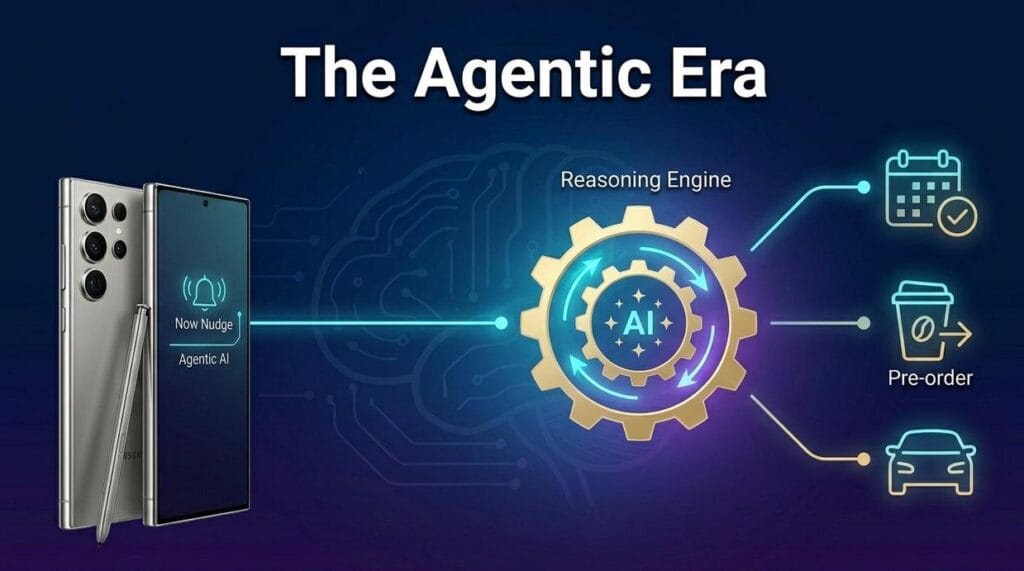
The “Reasoning Engine” and Bixby’s Rebirth
Samsung’s “Personal Data Engine” (PDE) is the key feature in the latest industry highlights from Galaxy Unpacked 2026. Here, I think Samsung’s reasoning engine agentic AI finally edges out Apple’s Siri.
- Intent-Aware Suggestions: According to Samsung Newsroom, “Now Nudge” is a conceptual feature that demonstrates how future agentic AI could transition from passive assistant to active decision-maker. Rather than just replying to messages, the AI would understand the context of a conversation as it was happening. For example, if you were texting a friend to set up a meeting, not only would the system suggest you add the meeting to your calendar, but it could also monitor live traffic, calculate the best time to leave and suggest nearby services, such as ordering a coffee to pick up on the way.
- The Death of App Switching: I think we are seeing the end of the “app era”. The S26 is an agentic AI with a “liquid UI”, which refers to a user interface that adapts fluidly to the user’s needs and context. You don’t even have to open the Uber app. You just tell your agent you need a ride, and it negotiates with the API behind the scenes.
2. The Silicon War: Snapdragon 8 Gen 5 vs. A20 Pro
The NPU-First Philosophy
Snapdragon 8 Gen 5 is an AI-first beast, while Apple’s A20 Pro chip is all about raw 2nm thermal efficiency.
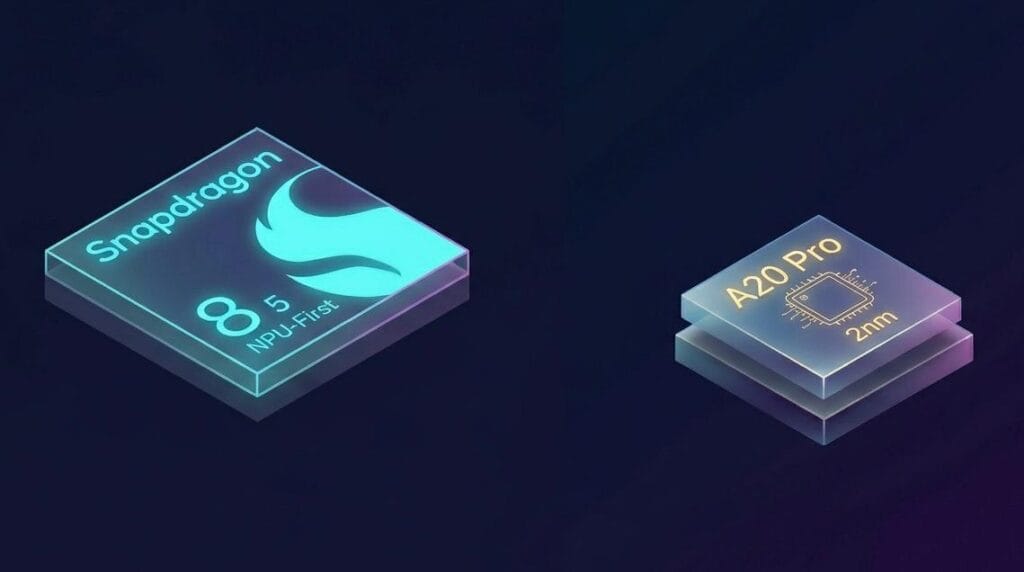
- The 39% NPU Leap: Samsung is reportedly co-developing a next-generation application processor for the Galaxy S26 Ultra, featuring an upgraded Neural Processing Unit (NPU) that could deliver up to 39% higher AI performance compared to its predecessor—potentially enabling faster on-device tasks like real-time translation, image generation, and advanced camera processing.
- On-Device Reasoning: The most important “expert” detail, in my opinion, is that this processing is done locally. Samsung is tackling the privacy paradox that has plagued cloud-based AI by employing Knox Enhanced Encrypted Protection (KEEP) to guarantee that your personal agent’s “thoughts” never leave the device.
3. Hardware for a High-Memory Future: The 24GB Standard
One area where I strongly believe Samsung is outmanoeuvring Apple is in memory architecture. To keep a reasoning engine resident in memory alongside modern games, 12GB of RAM is no longer sufficient.
- LPDDR6 Implementation: The Galaxy S26 Ultra is the first flagship to prioritise high-bandwidth LPDDR6 memory.
- The AI Buffer: My technical view is that Samsung is using a portion of this massive RAM pool as a dedicated “AI buffer”, allowing the personal agent to remain in a “hot” state. This eliminates the “wake-up lag” seen in current AI assistants.
4. Optical Mastery: The 200MP ISOCELL HP2 & Beyond
While Samsung is pivoting to software, they are not conceding the photography crown. The S26 Ultra utilises a refined ISOCELL HP2 sensor and a massive f/1.4 aperture.
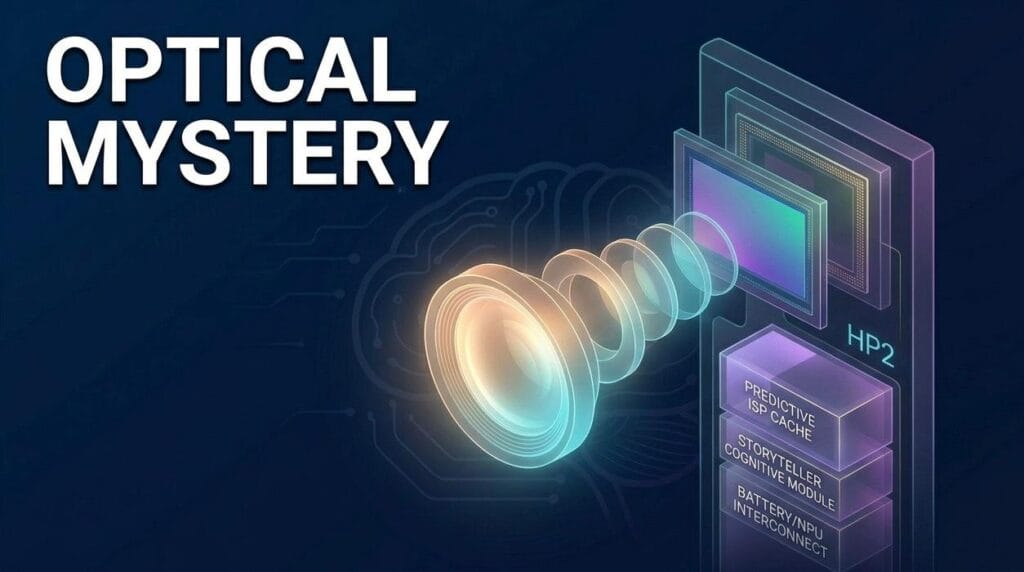
Semantic Reconstruction vs. Optical Bokeh
Apple is chasing “physical bokeh”. Samsung is taking the opposite path with the 200 ISOCELL HP2.
- Unlimited Semantic Segmentation: The S26 Ultra’s AI ISP (Image Signal Processor) can recognise unlimited layers in a photo. I think this technology creates a ‘synthetic reality’ which is often more aesthetically pleasing than raw optical capture. It’s not just taking a picture. It’s interpreting the scene and relighting it using professional studio principles in milliseconds.
5. A Comparative Analysis: The “Apple Roadmap” vs. “Samsung Vision”
To give you a definitive expert view, let’s look at how these two 2026/27 titans compare side-by-side.
| Feature | Apple Strategy (2026/27) | Samsung Strategy (2026) |
|---|---|---|
| Primary Goal | “Physical Minimalism” | “Digital Autonomy” |
| Key Tech | Under-display Face ID | Agentic AI (On-device) |
| Silicon Focus | 2nm Efficiency (TSMC) | Custom NPU (Agentic Edition) |
| Design Language | Portless iPhone 20 | Productivity (S-Pen Integration) |
The S-Pen as an “Agentic Wand”
I think the S-Pen has evolved from a drawing tool to a “selector”. On the S26 Ultra, you can use the S-Pen to “circle-to-act”. Highlight a complex legal document, and the agent’s AI can summarise it, highlight the risks, and automatically draft a reply to your lawyer. It seems Apple’s next devices won’t have this level of professionalism.
6. Battery and Thermal Innovation: The Stacked Revolution
Running a 24/7 AI agent is a huge drain. Samsung is responding to the rumoured 5,200mAh battery of the iPhone 18 Pro with EV-style technology.
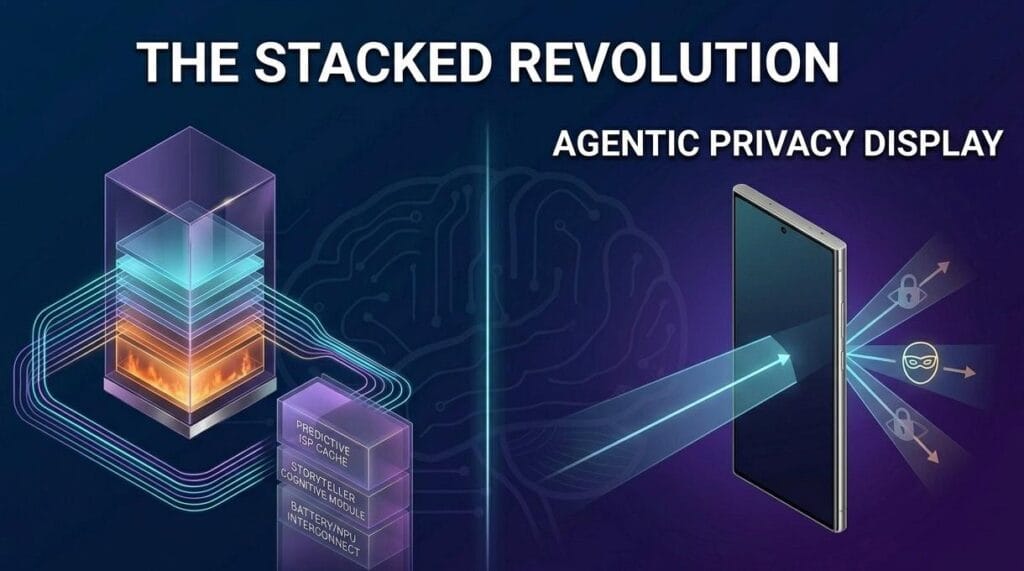
- Stacked Battery Design: By using a stacked architecture, Samsung fits 5,000mAh into a slimmer chassis while maintaining cooler temperatures during heavy AI inferencing.
- The Display Factor: The new 6.9-inch Dynamic AMOLED utilises a “Privacy Display” layer. In my view, this is a brilliant “Pro” feature—it limits side-viewing to protect your AI agent’s private interactions while you are in public.
7. The “Sustainability” Differentiator
Authenticity in 2026 is not just specs; it’s longevity. Samsung has officially promised seven years of OS and security updates, but there is a catch: “AI Brain Updates”. While Apple typically only releases new AI features on new hardware, Samsung is promising model updates to the S26’s Agentic AI for most of a decade. I think this adds a lot to the long-term resale value of the device.
8. Final Verdict: The Expert Choice
We are no longer choosing between two phones; we are choosing between two lifestyles.
- The iPhone 18 Pro/iPhone 20 is the choice for those who want the best hardware infrastructure. It is for the user who wants a beautiful, reliable, and perfectly engineered “vessel” for their digital life.
- The Galaxy S26 Ultra is the choice for the power user. If your life is a mess of emails, meetings, and logistics, Samsung’s Agentic AI is the only hardware currently on the market designed to actively reduce your “cognitive load”.
My Final Opinion: If you are planning an upgrade in late 2026, the S26 Ultra is the more “future-proof” investment because it fundamentally changes how you use a phone, rather than just changing how it looks.
What exactly is “Agentic AI” in the Galaxy S26?
Agentic AI is the next phase of mobile intelligence. Standard AI, such as the early chatbots, requires a prompt for every action, but the agentic AI within the Galaxy S26 is a “reasoning engine”. It can independently plan and execute multi-step tasks, such as rescheduling a flight and notifying your hotel, without you ever having to open a single app. It turns the phone from a passive tool into a proactive personal assistant.
How does the Galaxy S26 Ultra compare to the iPhone 18 Pro?
Between the two options, choosing one is a philosophical decision. Technical analysis shows that Apple is focusing on “hardware infrastructure,” improving the efficiency of 2 nm chips and the physical optics of the camera, such as the variable aperture. Samsung, meanwhile, is promoting “digital autonomy”. The iPhone is the ultimate physical device, while the Galaxy S26 is designed to be the ultimate digital companion, with a focus on software that handles your day-to-day life.
Does the Galaxy S26 Ultra feature a 300MP camera?
Rumours had been floating around 300MP, but current supply chain intelligence suggests that Samsung is going with a refined 200MP ISOCELL HP2 sensor. The magic in the S26 camera is not the number of pixels but the AI-ISP (Image Signal Processor). This enables “semantic reconstruction”, where the AI recognises every layer of a photo to apply professional studio lighting and detail reconstruction in real time.
Will the Galaxy S26 have a better battery than the iPhone 18 Pro?
The Galaxy S26 Ultra boasts a superior raw capacity, featuring a 5,500mAh stacked battery compared to the rumoured 5,200mAh in the iPhone 18 Pro. But the actual winner depends upon efficiency. The iPhone 18 Pro’s 2nm A20 chip is world-class for low power consumption, but Samsung’s use of EV-style stacked battery technology enables 65W fast charging, giving it an edge for power users.
Is the Galaxy S26 Ultra worth waiting for if I have an S25?
In my expert opinion, yes. The jump from S24 to S25 was incremental, but S26 is the biggest architectural change in Samsung’s history. The switch to LPDDR6 RAM (24GB) and the addition of a “Reasoning Engine” make the S26 a “future-proof” device that will be relevant for the next 7 years of AI development.