The iPhone has always been about the balance between hardware mastery and software innovation. It’s May 2026, and we’re here, with the tech world preparing for the next big milestone, iOS 27. iOS 27 is poised to be one of the biggest upgrades in Apple’s history with a visual transition called “Liquid Glass” last year. Internally some are calling the update a “Snow Leopard” release, but it’s not so much about changing the way the phone looks but changing the way it thinks at a fundamental level. iOS 27 is the age of the “Agentic iPhone,” from the rumoured standalone Siri app, “Project Campo” to Apple Intelligence expanding into every corner of the UI.
Table of Contents
1. iOS 27 Roadmap: Key Dates and Release Cycle
Apple is highly accurate, like a Swiss watch, with its software cycles. The 2026 calendar will likely stick to the usual cadence, with the Worldwide Developers Conference (WWDC) as its home base.
WWDC 2026 Keynote (June 8, 2026)
The world will get its first official look at iOS 27 on June 8. Traditionally, the keynote serves as the stage for “The Big Reveal”, where Craig Federighi and Tim Cook walk through the headline features.
Developer Beta 1 (June 8, 2026)
Within minutes of the keynote concluding, the first developer beta will be released. This version is strictly for app developers to ensure their software doesn’t break under the new architecture.
Public Beta (Early July 2026)
After three rounds of developer testing, Apple typically releases the beta to the public via the Apple Beta Software Program. This lets fans try out features like the new Siri chatbot before the official launch.
General Release (September 2026)
The “Gold Master,” or final version of iOS 27, will likely debut in the second or third week of September, alongside the iPhone 18 and iPhone 18 Pro launch.
2. Compatibility: The A13 Bionic “Great Filter”
Eventually, every significant iOS upgrade has to leave some hardware behind to keep the software running smoothly. The “Great Filter” for iOS 27 is rumoured to be the A13 Bionic chip.
Why the Cut-off?
The A13 Bionic (from 2019) doesn’t have the dedicated Neural Engine cores to run the “Apple Intelligence 3.0” features that are hallmark to iOS 27. So the following devices are supposed to be dropped:
- iPhone 11, 11 Pro, and 11 Pro Max
- iPhone SE (2nd Generation)
The Full iOS 27 Compatibility List (Expected)
- iPhone 18 Series: (Standard, Plus, Pro, Pro Max, and the rumored “Ultra”)
- iPhone 17 Series & iPhone Air: Full support for all features.
- iPhone 16 Series: Supports Apple Intelligence, though some exclusive “Pro” features may be missing.
- iPhone 15 Pro & Pro Max: The oldest devices capable of running the full suite of AI tools.
- iPhone 15 / 15 Plus: Will receive iOS 27 but likely miss out on advanced generative AI features.
- iPhone 14 Series: Will run the core OS but with limited AI capability.
- iPhone 13 Series: The “Standard” support tier.
- iPhone 12 Series: This will likely be the oldest supported generation.
- iPhone SE (3rd Generation): Supported due to the A15 Bionic chip.
3. Siri 3.0: From Voice Assistant to Standalone App
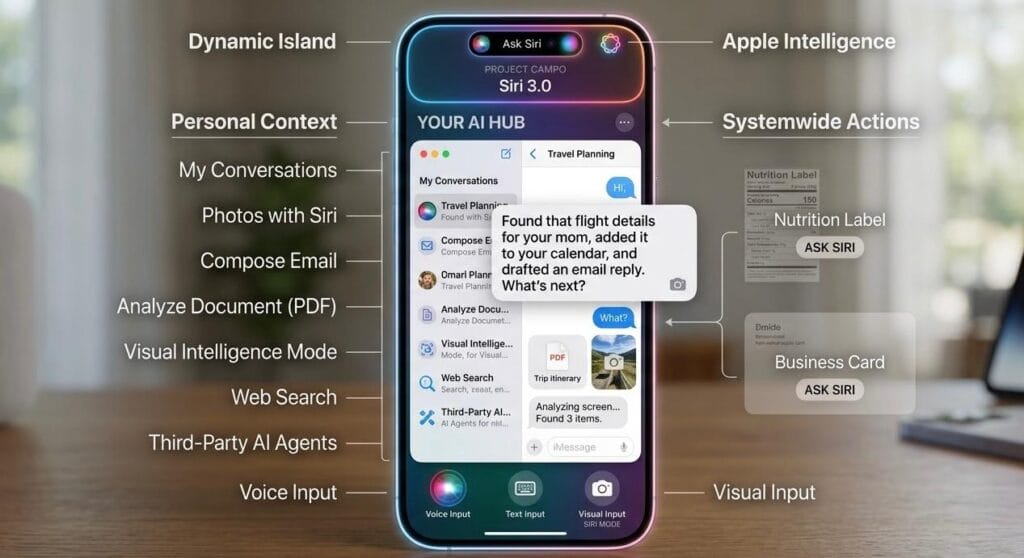
The headline feature of iOS 27 is a complete reimagining of Siri. Siri has been an overlay for more than a decade, a glowing orb that intrudes on your screen. iOS 27 is codenamed Project Campo, and Siri becomes an independent app.
The Chatbot Interface
The new Siri app looks remarkably like iMessage. It allows for:
- Persistent Conversation History: Now you can scroll back and view your previous queries and responses from Siri.
- Text-First Interaction: The app still prioritises voice, but it has a large text bar for when you can’t speak out loud.
- Multi-Command Support: You can now issue complex, multi-part commands. For example: “Hey Siri, get the flight details from my email, put them in my calendar and remind me to pack my bags two hours before I leave.
Siri Extensions & The AI Marketplace
Perhaps the most revolutionary is the rumoured “Extensions” system. Apple is said to be letting users pick which AI model handles what.
- Apple’s On-Device Model: Supports privacy-sensitive tasks, like messaging and calendars.
- Google Gemini / Claude / ChatGPT: Apple would be the safe gateway, and users can switch on these “extensions” in the Siri app to handle creative writing or complex coding questions.
4. Apple Intelligence 3.0: Agentic AI
If 2025 was about “generative AI” (making images and text), 2026 is about “agentic AI”—software that can act on your behalf across different apps.
On-Screen Awareness
Siri is much more aware in iOS 27. If you’re looking at a photo of a restaurant on Instagram, you can say, “Siri, what are the reviews for this place?” You don’t even have to say the name. Siri will look at the screen and show the information immediately.
Visual Intelligence Upgrades
The camera app is receiving its own “intelligence” layer:
- Nutritional Tracking: Point your camera at a food label, and the phone will read the information off and ask you if you want to enter it directly into the Health app.
- Business Card Integration: Scan physical cards to instantly create contacts with all fields (email, address, and LinkedIn) populated.
- Wallet Digitization: Point your camera at an event’s paper ticket, gym card, or ID, and it will create a digital pass for your Apple Wallet instantly.
Safari: Smart Tab Management
Safari is generally the biggest mess on an iPhone. iOS 27 is getting Smart Tab Grouping from Apple. The AI will analyse the content of your 50+ open tabs and automatically classify them as “research”, “shopping”, or “work”, giving them smart names based on the context.
5. Connectivity: The 5G Satellite Era
One rumoured feature of iOS 27 is a highly technically impressive extension for satellite connectivity. Currently, satellite features only cater to text-based emergencies. But iOS 27, plus the new modems in the iPhone 18 Pro, is likely to change that by enabling users to send and receive not only text messages but also images and possibly make voice calls in areas without cellular coverage.

5G Non-Terrestrial Network (NTN)
This technology allows the iPhone to link up with satellites for data-intensive jobs without a specialised “pointing” interface.
- Satellite Photos: Now you can send high-quality photos through Messages even when you’re miles from the nearest cell tower.
- Offline Maps via Satellite: Apple Maps will be able to update traffic and route data in real time via satellite, revolutionising the experience for hikers and rural travellers.
- Third-Party API: Apple is reportedly working on an API that will allow apps like Strava and WhatsApp to ping and update locations using satellite data.
6. Design & Customization: Refining “Liquid Glass”
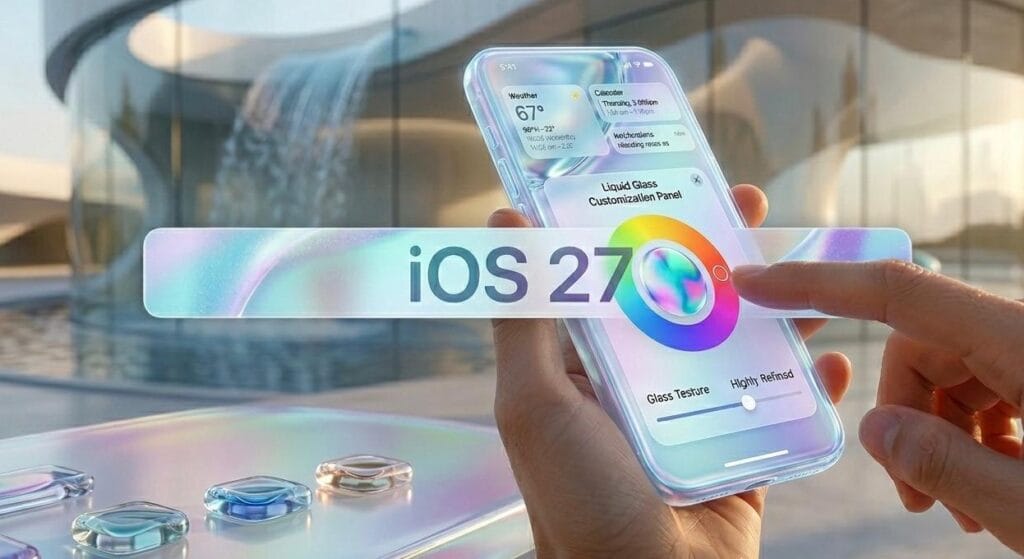
While iOS 27 is a performance-first update, it does introduce several key aesthetic refinements to the “Liquid Glass” design language introduced in iOS 26.
Dynamic Interface Sliders
Apple is giving users more control over the “look” of the OS:
- Transparency Sliders: You can now adjust how “glassy” your menus look, choosing between a deep frosted look or a more transparent aesthetic.
- Home Screen Undo/Redo: A small but highly requested feature—if you accidentally mess up your meticulously organised home screen, iOS 27 includes a “Shake to Undo” for icon placement.
Control Center 2.0
The Control Center is expected to become even more modular. In iOS 27, third-party developers can create “Mini-Apps” for the Control Center—compact versions of their apps that function entirely within the pull-down menu.
7. Privacy and Security: The “Private Cloud Compute” Expansion
As AI becomes more integrated, privacy remains the primary concern. iOS 27 introduces Enhanced On-Device Masking.
For any query that requires the cloud, iOS 27 will “strip” your personal identifiers before sending the data. Furthermore, Apple is expected to expand its “Private Cloud Compute” (PCC) infrastructure globally, ensuring that even when using large language models, the servers are cryptographically verified to delete your data the moment the task is complete.
8. The “Foldable” Foundation
With rumours of a foldable iPhone (or “iPhone Flip”) swirling for a late 2026 release, iOS 27 is expected to include the underlying framework for “Continuity UI”. This feature allows an app to seamlessly transition from a 6.1-inch external display to a larger 8-inch internal display, automatically adjusting the layout—much like iPadOS does today.
Conclusion: A Mature Intelligence
iOS 27 is a major turning point for Apple. It’s not about adding “features” anymore; it’s about building a cohesive, intelligent layer that sits on top of everything you do. Focusing on Siri, bolstering satellite capabilities and embracing agentic AI, or artificial intelligence that can act independently on behalf of users, Apple is making sure the iPhone stays the most essential tool in your pocket. WWDC 2026 showed that the future of iOS is not about what you can do with your phone but rather what your phone can do for you.
Quick Comparison: iOS 26 vs. iOS 27
| Feature | iOS 26 (Current) | iOS 27 (Expected) |
|---|---|---|
| Siri Interface | Compact Overlay | Standalone “Chat” App |
| Siri Intelligence | Basic Intent Recognition | On-Screen Awareness & Multi-Command |
| Satellite Support | Text ‘Emergency SOS’. | 5G Photos & Satellite Apple Maps |
| Camera AI | Basic Object Lookup | Nutritional & Contact Scanning |
| System Theme | Fixed Liquid Glass | Customizable Transparency |
| Min. Chipset | A12 Bionic | A14 Bionic |
When is the official release date for iOS 27?
Apple is expected to preview iOS 27 at the Worldwide Developers Conference (WWDC) on June 8, 2026. The final public release is expected by late summer 2026 (around mid-September), following a summer beta testing phase . The timing would align with the launch of the iPhone 18 series.
Which iPhones will be compatible with iOS 27?
iOS 27 is expected to be compatible with iPhone 12 and later. Unfortunately, the news means the iPhone 11 series and the iPhone SE (2nd Gen) will probably lose support this year as Apple moves to a minimum requirement of the A14 Bionic chip.
What is the “Siri Standalone App” in iOS 27?
One big rumour for iOS 27 is the launch of its own Siri app. The current overlay will be replaced by an app that has a chat-style interface with a history of your past interactions, allowing you to easily switch between voice and text commands, like ChatGPT or Google Gemini.
Will iOS 27 support satellite connectivity for regular apps?
“Yes.” Apparently Apple is set to release a satellite API for third-party developers. This would enable apps such as WhatsApp or Strava to send basic data or location updates by satellite in areas without cellular coverage. The iPhone 18 Pro is also expected to get Apple Maps via satellite.
Does iOS 27 require a specific iPhone for Apple Intelligence 3.0?
The Core iOS 27 update will work on many iPhones, but the full “Apple Intelligence” suite—including advanced on-screen awareness and the Siri chatbot—will likely require an iPhone 15 Pro or newer. That’s because of the 8GB RAM requirement and the advanced Neural Engine inside the A17 Pro and A18 chips.
What are the “Siri Mode” features in the Camera app?
iOS 27 is expected to add a “Siri Mode” to the camera. This uses Visual Intelligence to perform real-time tasks like scanning a nutrition label to log calories in the Health app or instantly converting a physical business card into a digital contact.