For most of the last decade, we have lived in the age of “The Great Centralisation”. Our data went on a digital pilgrimage when we asked a voice assistant a question, translated a sentence or added a filter to a photo. The data would leave our portable devices and travel through a labyrinth of fibre-optic cables to reach enormous, energy-guzzling data centres located in distant areas only to be sent back a few milliseconds later with a response.
But the winds are blowing. What we are witnessing in 2026 is a “Great Localisation”. Silicon chips in our pockets now squeeze the intelligence that once required a warehouse full of servers, enabling powerful computing capabilities that allow for real-time data processing and decision-making directly on our devices. On-device AI has become the standard for privacy, performance, and autonomy.
Table of Contents
1. The Death of Latency: The Speed of Thought
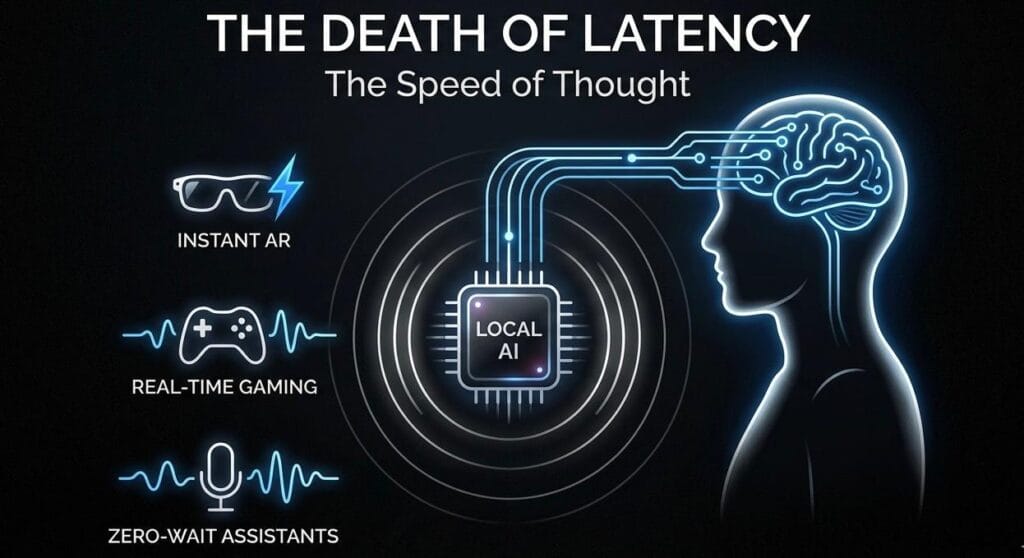
In the world of computing, latency is the enemy of immersion. When you talk to a cloud-based AI, you’re at the mercy of your ping. Even with 5G or 6G connectivity, the physical distance the data must travel creates a “lag” that makes AI feel like a tool you use rather than an extension of your mind.
The Near-Zero Latency Advantage
On-device AI benefits start with the elimination of the round-trip. When the model lives on your hardware, the “inference” (the process of the AI coming to a conclusion) happens at the speed of your device’s internal bus.
- Real-Time Augmented Reality (AR): For AR glasses to work, they must identify objects in your field of vision instantly. A 500ms delay in the cloud could mean the difference between a helpful label and a dizzying, lagged-out visual mess.
- Gaming: Now, on-device AI is generating textures and NPC dialogue on the fly without ping spikes, creating worlds that respond to the player at the speed of a local processor.
- Voice Interface: We are moving toward “Zero-Wait” assistants. By running the speech-to-text and the LLM locally, the conversation feels naturally human-like rather than a series of prompts and pauses. We are already seeing the software foundation for this in the early leaks surrounding [iOS 27 features], where system-wide integration of local models aims to eliminate Siri’s traditional cloud lag.
2. The Privacy Paradigm: Your Data, Your Silicon
If speed is the engine of the on-device movement, privacy is the fuel. In the early 2020s, we traded our data for convenience. In 2026, the “Privacy Paradox” has been solved by the realisation that we can have world-class intelligence without surrendering our “digital soul”.
Private AI vs. Cloud AI: The Invisible Wall
When you use a cloud-based LLM, your prompt, be it a sensitive business strategy, a personal journal entry, or a medical query, is stored on a server. Even if it is anonymised, it is used to “fine-tune” future models. Your intelligence effectively becomes a public commodity.
On-device AI builds an invisible wall around your hardware.
- Local Inference: The data is processed in the RAM and then discarded or stored in an encrypted local vault.
- No Account Necessary: Many offline AI tools don’t even require a login. The “user” is the owner of the hardware, not a line item in a corporate database.
- End-to-End Encryption by Default: Because the data never leaves the device, there is no “man-in-the-middle” risk. For industries like defence, healthcare, and law, this approach is the only acceptable path forward for AI integration.
3. Connectivity Independence: The “Offline AI” Frontier
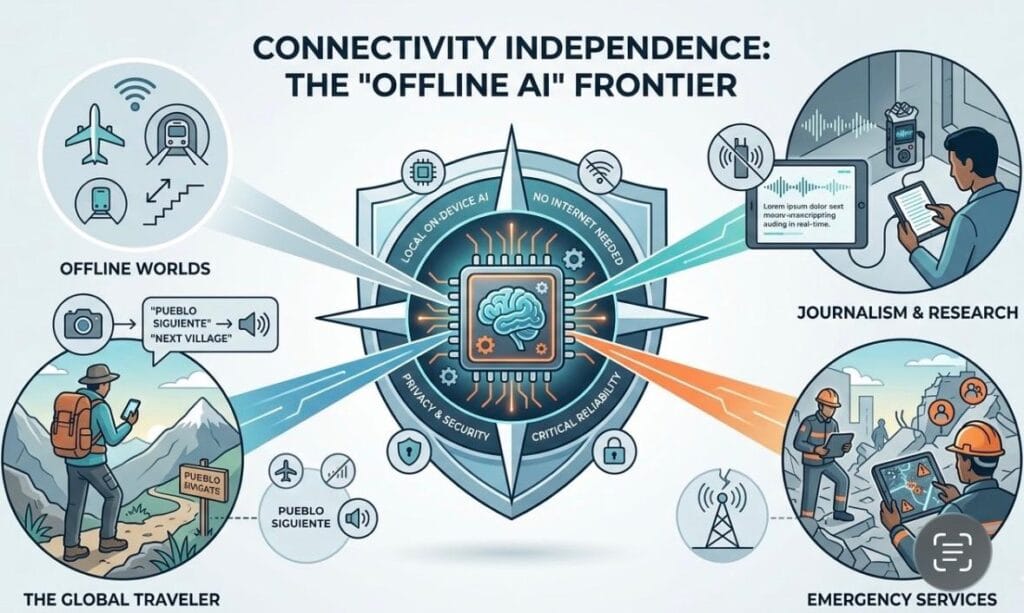
We’ve become dangerously dependent on being “connected”. Yet the real world is full of basements, aeroplanes, remote hiking trails, and subway tunnels. With AI but without the internet on smartphones, these dead zones are transforming into productive workspaces.
Use Cases for the Offline World
- The Global Traveller: Imagine being in a rural village in the Andes with zero cell service. An on-device translation model allows you to point your camera at a sign or speak to a local merchant with near-perfect accuracy.
- Emergency Services: In disaster zones where cell towers are down, first responders can use local AI to analyse satellite imagery or triage patient symptoms on ruggedised tablets.
- Journalism and Research: Recording an interview in a high-security area where signals are jammed, yet having the device provide a real-time, local transcript as you speak.
4. The Hardware Renaissance: NPUs and TinyML
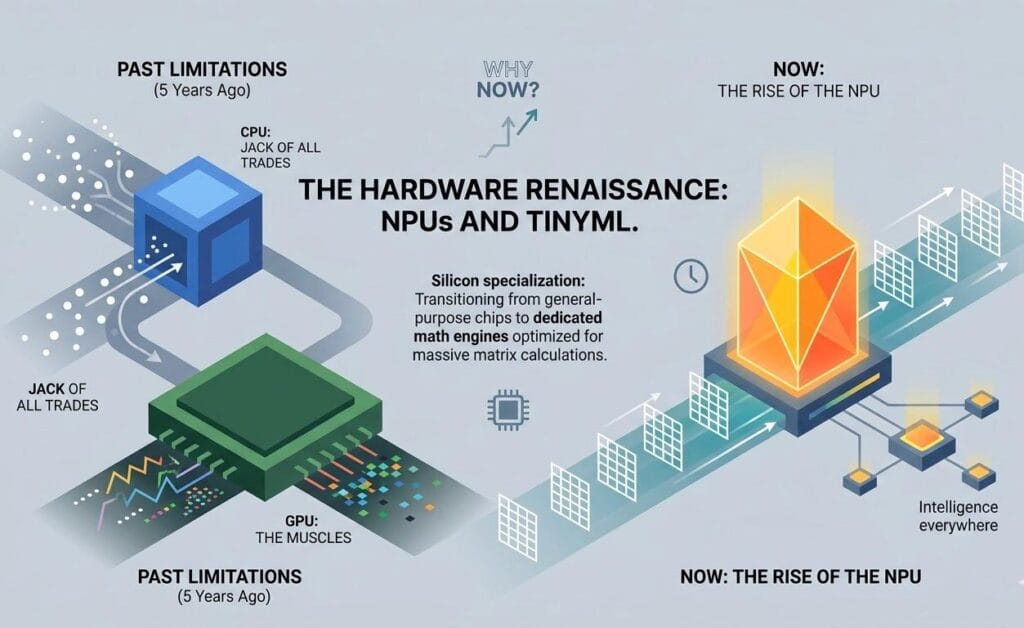
Why is this transformation happening now and not five years ago? The answer lies in the silicon.
Historically, CPUs (Central Processing Units) were the “jacks of all trades”, and GPUs (Graphics Processing Units) were the “muscles”. But AI requires a different kind of maths: massive amounts of simple matrix multiplications. Enter the NPU (Neural Processing Unit).
The Rise of Dedicated Silicon
Every major chipmaker, from Apple’s A-series and M-series to Qualcomm’s Snapdragon and Google’s Tensor, now dedicates a massive portion of its “die area” to the NPU. These chips are:
- Highly Specialised: They do one thing (AI maths) incredibly well.
- Energy Efficient: They can run a 7-billion-parameter model while using less power than a standard screen-brightness setting.
- Parallelised: They can handle multiple AI tasks like Face ID, voice recognition, and photo enhancements simultaneously without slowing down the OS.
Model Compression: The Art of “Quantization”
The other half of the hardware story is its software. Developers have become experts at quantisation, a technique that reduces the precision of a model’s weights (say, from 32-bit to 4-bit). This brings the model down from 50GB to 4GB, with no loss of “common sense” or reasoning ability. That means the “average” phone can have a genius-level assistant.
5. The Economics of Scale: Why Big Tech Wants to Offload
While we focus on the user benefits, the “Big Tech” giants have a multi-billion dollar reason to push for on-device AI server costs.
Running a model like GPT-4 or Claude in the cloud is an ecological and financial nightmare. Each query requires:
- Electricity to power the H100 GPUs.
- Water is used to cool the data centres.
- Massive bandwidth to move the data.
By pushing the “thinking” to the user’s device, companies like Google, Apple, and Microsoft effectively turn billions of smartphones into a distributed supercomputer. They provide the model, but you provide the electricity and the hardware. This allows them to offer AI features to billions of people without their operational expenses scaling linearly. It is the ultimate “win-win” for corporate margins and user privacy.
6. The Impact on Different Industries
Photography and Videography
We have already seen “computational photography”, but on-device AI is moving into “generative videography”. Phones can now “hallucinate” missing frames in a low-light video or remove an entire person from a 4K clip locally. This used to require a desktop workstation; now it’s a toggle in a gallery app.
Cybersecurity
On-device AI is the ultimate personal bodyguard. It can monitor system calls in real-time to detect malware behaviours that antivirus labs haven’t even identified yet (zero-day attacks). And it’s local, so it can shut down a process in milliseconds faster than any cloud-based security suite could ever react.
Personalized Education
Imagine a tutor sitting on a child’s tablet. It learns the child’s specific weaknesses, remembers past mistakes, and customises lessons without ever sending the child’s voice or image to a server. This provides a secure ‘walled garden’ for learning.
7. The Challenges: What’s Still Holding Us Back?
While the trend is clear, we aren’t at 100% localisation yet. There are still hurdles to clear:
- The Knowledge Cap: A local model can “reason” well, but it doesn’t have the entire index of the internet stored in its brain. For facts about something that happened five minutes ago, the cloud is still the best.
- Battery Drain: While NPUs are efficient, heavy AI use still drains power faster than traditional apps.
- Storage Space: A high-quality local LLM can take up 5GB to 15GB of storage, a significant chunk for users with base-model devices.
8. Summary: The Future is Hybrid, then Local
The immediate future (2026-2027) is hybrid AI. Your device will act as a “triage” centre. This transition is the primary battlefield in the current competition [Samsung Agentic AI vs iPhone 18 Pro], as manufacturers race to see whose local ‘agent’ can handle the most complex tasks without phoning home.”
- Level 1: Simple tasks (texting, basic photo edits, scheduling) stay on-device.
- Level 2: Complex tasks (researching a 50-page paper) go to a private cloud.
- Level 3: Massive tasks (simulating weather patterns or global data analysis) go to the Public Cloud.
However, as quantisation improves and NPUs become even more powerful, the “Level 2” tasks will move to the device. Eventually, the cloud will be reserved for only the most gargantuan of tasks, while our personal devices become truly intelligent companions.
Conclusion: Reclaiming the Edge
The move to on-device AI is the “coming of age” for the digital world. We are moving away from the brittle, centralised world of the 2010s and into a more resilient, private, and faster, decentralised future.
On-device AI isn’t just about making your phone smarter. It’s about putting you back in the driver’s seat. It’s about an AI that works for you, on your terms, in your pocket, and only with your permission. The cloud is not going away, but it is no longer the center of the universe. The center of the universe is now the device that you’re holding in your hand right now.
A Quick Checklist for the AI-Savvy Consumer
If you’re looking to stay ahead of this trend, keep these things in mind when upgrading your tech:
- Check for an NPU: When buying a phone or laptop, look at the “TOPS” (trillions of operations per second) rating of the processor.
- Look for “Local-First” Apps: Support developers who prioritise local processing over cloud-based subscriptions.
- Manage Your Storage: On-device AI requires room to think, so opt for higher storage capacities (256GB+) to accommodate local models.
- Value Your Privacy: Remember, if the AI is free and it’s in the cloud, you are the product. If the AI is on your device, it is the product.
What is on-device AI?
On-device AI means your phone or laptop has its own “built-in brain” that does the processing locally, rather than constantly checking in with a remote server. Your device does the work itself instead of sending your private data to the cloud every time you want to edit a photo or use voice-to-text. That means things feel a lot snappier, because there’s no lag from data going back and forth, and it’s a huge win for privacy, because your personal data never actually leaves your hand.
Is on-device AI more private?
Exactly. On-device AI is a vault for your digital life. When your data never leaves your hardware, you’re not just crossing your fingers and hoping a tech company will do right by your info; you’re physically keeping it out of their reach. This setup kills the “if it’s in the cloud, somebody else owns it” problem and puts you in total control of your most personal files and conversations.
What is an NPU in modern smartphones?
That’s a good analogy. If the main processor (the CPU) is like a “jack-of-all-trades” trying to do all the apps at the same time, the NPU is the specialist chef who sticks to their lane and does the heavy AI maths with incredible speed. The NPU is so good at these particular tasks that the rest of your device doesn’t have to sweat. This means your phone won’t turn into a pocket heater when you’re blurring a video background or translating speech, and you won’t have to constantly chase down a charger by lunchtime. That’s basically the secret sauce that makes “smart” features not feel like a battery drain.
Can AI work without an internet connection?
Yes, on-device AI. It really is a game changer for travel and the outdoors. Essentially, you’re lugging around a high-tech toolkit that doesn’t die the second you lose signal. The device is self-contained whether you’re on a far-flung trail or decrypting a sign in a deep underground tube station. It turns your tech from a “window” to the internet into a real independent assistant that works when and where you do.
Will cloud AI disappear completely?
Exactly, the future is not a complete takeover; instead, on-device AI and cloud AI will work together, not one or the other, but a smart “best of both worlds” partnership. Your device will do the personal, everyday stuff locally to keep things fast and private, while the cloud remains the heavy hitter for massive research and complex data crunching. This hybrid approach gives you a snappy, secure assistant in your pocket while still having access to the global supercomputing power needed for the really big stuff.
Why are companies investing heavily in on-device AI?
A massive win-win for everyone: users get faster, more private experiences, while companies save a tonne of money on electricity and server upkeep. Tech brands can bring smart features to billions of people without building a huge, expensive data center for every new update by letting your phone do its own ‘thinking’. Basically, it makes running high-end AI cheaper, easier to scale and much more sustainable in the long run.