Table of Contents
Introduction:
For years, the smartphone industry has treated RAM as a highly competitive race. Every new flagship release brought with it a constant progress in memory specifications from 8GB to 12GB, 16GB and, finally, to the mind-blowing heights of 24GB on paper. On paper it sounded impressive. More RAM means faster speeds and a device that would not become obsolete. But in daily use, most people never come close to using that much. Now, many users are asking a critical question: How much RAM does a smartphone need in 2026?
Today’s modern mobile computing is so efficient that it has finally surpassed the need for sheer volume. The integration of the latest chipsets and AI-powered memory optimisation makes it clear why smartphones don’t need more RAM. The question is not how much memory you have, but how smartly your phone uses it.
The Fundamental Role of RAM
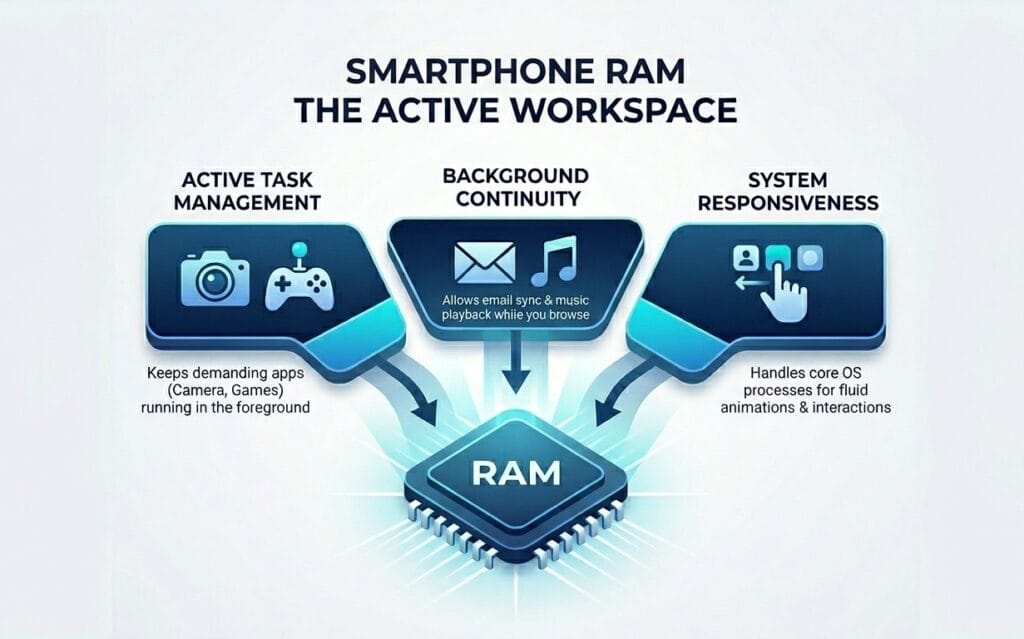
So, let’s first get to understand the smartphone RAM requirements in 2026. RAM is your device’s short-term memory or its active workspace. When you fire up an app, your phone pulls that data from its permanent storage and throws it into the RAM “workspace” so the processor can grab it on the fly, keeping everything snappy and responsive instead of making you wait for the digital equivalent of a filing cabinet search.
- Active Task Management: RAM keeps your current apps, such as your camera or a high-end game, running in the foreground.
- Background Continuity: It allows your email client to sync or your music to play while you are browsing.
- System Responsiveness: It handles the core OS processes that ensure your home screen swipes feel fluid.
Why the “RAM Wars” Ever Happened
The fixation on large RAM counts was not a marketing ploy; it was at one point a necessity. A few years ago, many Android phones were constantly reloading apps. That is why buyers naturally started associating more RAM with smoother performance. The following are reasons for RAM wars.
- Marketing Strategy: Manufacturers used high RAM numbers as an easy-to-understand metric for power.
- Lack of Optimisation: Early versions of Android lacked the strict background process controls we see today.
- The Specs Battle: Brands pushed flagship models with more RAM for a better user experience.
- Consumer Psychology: People naturally associate bigger numbers with long-term support.
This created a “spec-chasing” culture where fans thought that a phone with giant storage was just better. However, most of those additional gigabytes were doing nothing but draining power and offering no real benefit to the user experience for everyday tasks.
The Intelligence Revolution: Smarter Chipsets
The main reason why smartphones don’t need more RAM today is the evolution of the System on a Chip (SoC). Today’s processors from big industries are not just CPUs and GPUs; they are also highly complex hubs of specialised silicon. According to Android developers’ documentation, today’s flagship chips come equipped with dedicated neural processing units (NPUs) that manage memory efficiently. According to the big companies like Apple and Qualcomm, today’s processors aren’t just CPUs and GPUs; they’re a complex system of specialised silicon. The flagship chips of today come with dedicated neural processing units (NPUs) to do the heavy lifting of memory management.
Instead of needing a massive bucket to hold all your data, modern chipsets act like high-speed filters. They ensure that only the most critical data is taking up space, and they can swap data in and out of the “active” zone so quickly that the user never notices a transition.
The Secret of iOS: Optimization Over Capacity
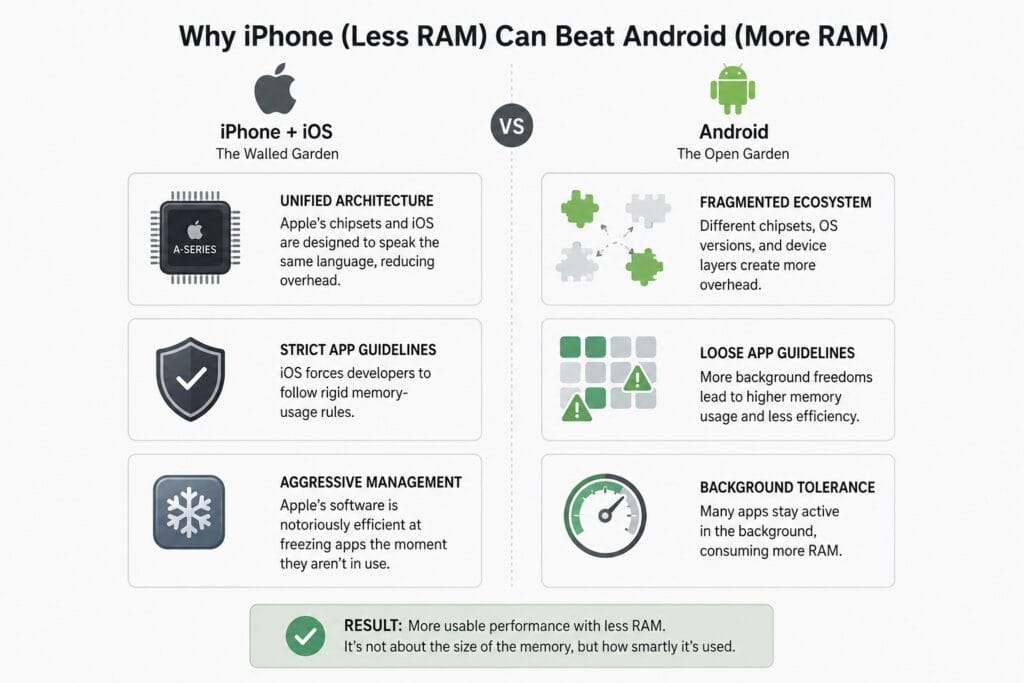
The “iPhone vs Android RAM” debate remains a constant in tech discussions. This is also part of the broader difference between iOS and Android optimisation philosophies, especially in areas like privacy, background activity, and system control. People often wonder how the iPhone can be as fast, or even faster, than an Android flagship with double the memory. The reason is Apple’s “walled garden” approach. They control every link in the hardware and software chain.
- Unified Architecture: Apple’s chipsets and iOS are designed to speak the same language, reducing overhead.
- Strict App Guidelines: iOS forces developers to follow rigid memory-usage rules.
- Aggressive Management: Apple’s software is notoriously efficient at freezing apps the moment they aren’t in use.
Android’s Modern Transformation
For a long time, Android was criticised for being RAM-hungry. Because the OS has to run on thousands of hardware combinations, it naturally required more overhead. However, in 2026, Android has closed the gap significantly. Google has introduced deep architectural changes that allow Android to behave much more efficiently.
- Adaptive Memory Systems: After a few weeks, modern smartphones usually learn your habits and which applications you open most and keep them open in the background.
- Predictive Caching: The system anticipates your next move, loading the “next” page into memory before you tap.
- Enhanced Restrictions: Android now limits how much “noise” a background app can make.
These software leaps mean that the “RAM penalty” previously associated with Android has largely disappeared.
Is 8GB RAM Enough in 2026?
Many manufacturers are going back to 8GB for their base models as they try to get the best balance of cost and performance. This has led many consumers to ask, Is 8GB RAM enough in 2026? For most users, the answer is a big yes. If you aren’t running specialised workstation tasks on your mobile device, then 8GB is an absolutely smooth experience.
- Social Media & Browsing: 8GB can comfortably hold multiple social apps and dozens of browser tabs without refreshing.
- High-Definition Streaming: Watching 4K content or multitasking with Picture-in-Picture works flawlessly.
- Standard Gaming: Most popular mobile titles are optimised to run perfectly on 8GB devices.
- On-device AI: Basic AI photo editing and voice assistants run without any lag on this capacity.
Do Phones Need 16GB RAM for Gaming?
We are told memory is the key to success in the gaming community. This naturally raises the question: do phones need 16 GB RAM for gaming? Personally, 16 GB RAM in a smartphone still feels more like marketing than necessity, but that’s seldom the deciding factor in how a game will perform in practice.
- Thermal Throttling: A phone with 16GB of RAM will still lag if the cooling system fails to keep the processor from overheating.
- Asset Management: In real life most of the games run smoothly on 8 GB or 12 GB phones. Usually the phone heats up before the RAM becomes the problem.
If you’re a typical gamer, then 12GB of RAM is the best option. It has enough power to handle heavy games without breaking a sweat. Raising it to 16GB feels more like a “luxury flex” than a necessity; it’s definitely nice to have that extra breathing room, but you rarely see it actually give you a competitive edge or a noticeable boost in how your games play day-to-day.
AI: The Invisible Hand of Performance
If 2026 is the year of anything, it’s the year of on-device artificial intelligence. AI is no longer just a voice assistant. It’s the secret power that makes your phone work. AI uses your existing resources with perfect accuracy and does not require massive amounts of hardware.
- App Usage Prediction: The AI ensures your favourite apps are ready to go, even if they were previously “closed”.
- Intelligent Compression: AI can identify which parts of an app’s data are redundant and compress them.
- Thermal Balancing: AI monitors system heat and adjusts performance to ensure the phone doesn’t throttle.
The phone uses machine learning to understand the user’s behaviour and create the illusion of infinite memory. It doesn’t matter how much physical hardware you have if the AI can make sure that the specific data you need right now is always available.
The Impact of Ultra-Fast Storage

One of the most overlooked factors in the death of the RAM race is the speed of modern storage. In the past, moving data from your permanent storage to your RAM was a slow process. According to Samsung’s UFS 4.0 overview today, technologies like UFS 4.0 and next-generation NAND have bridged that gap entirely.
- Blazing Transfer Speeds: Modern storage can move gigabytes of data in a fraction of a second.
- Swap Memory: Phones now use “Swap” technology to use storage as an “overflow” for RAM.
- Zero-Lag Reloads: Reopening an app from storage feels almost as fast as pulling it from active memory.
Fast storage is one of the biggest reasons modern phones feel smoother today without massive RAM. Smartphone RAM requirements in 2026 depend on multiple factors, such as faster storage and faster chipsets.
The Marketing Myth: Why Extreme RAM Still Exists
If research says we don’t need it, why do you still buy a phone with 24GB of RAM? “The answer is human psychology and competitive marketing. In a crowded market, manufacturers need “hero specs”, numbers that will look appealing on a billboard.
- Enthusiast Appeal: There is a niche market of users who simply want the highest numbers possible.
- Future-Proofing Narrative: Salespeople use high RAM counts to convince buyers that the phone will last longer.
- Pricing Tiers: Adding more RAM allows a company to justify a much higher price tag for “Ultra” models.
For the average person who scrolls social media and takes photos, owning these extreme specs is like buying a 1,000-horsepower car just to drive to the grocery store.
Often buyers would benefit more from choosing a phone with a better camera system or processor rather than simply choosing bigger RAM numbers. Read our detailed iPhone vs Samsung camera comparison.
A Final Verdict on Memory in 2026
When you look at how much RAM a smartphone needs in 2026, you see that we are at a point of equilibrium.
- Budget/Entry Level: 6GB is the absolute minimum, suitable for basic tasks.
- The Ideal Standard: Is 8GB RAM enough in 2026? Yes, it is perfect for most people.
- The Power User: 12GB is ideal for those who do heavy video editing or extreme multitasking.
- The Niche: Do phones need 16GB RAM? Only for those who want the absolute top-tier specs for experimental use.
The real innovation in 2026 isn’t happening in the factory that makes the RAM modules; it’s happening in the labs that are making the software smarter. The future of the smartphone is a device that runs its own internal world so efficiently you’ll never have to think about specs again. The upcoming modern smartphone is one that controls its internal environment to such an extent that specifications are no longer a concern.
For most buyers software optimisation now matters more than chasing huge RAM numbers. Realistically most people upgrading from 8 GB to 16 GB would notice the price difference more than the performance difference.
How much RAM does a smartphone need in 2026 for AI features?
Tools like Google Gemini and Galaxy AI still occupy about 2GB to 3GB of dedicated RAM. If you want features like live translation and AI photo editing to feel instant rather than laggy, 8GB is now the absolute baseline, while 12GB is presently the gold standard for power users.
Is 8GB RAM enough in 2026 for Android 16?
The newer Android version now manages background memory far more than older releases. This technology compresses inactive background apps, making 8GB of physical RAM act like 12GB. 8GB is still the sweet spot for value and speed for 90% of users.
Why don’t smartphones need more RAM?
Modern storage is now so fast that it acts as virtual RAM. When your physical memory fills up, the phone swaps data to the storage drive instantly with zero lag, making massive 16GB or 24GB modules unnecessary for daily tasks.
Can I upgrade my phone’s RAM if it feels slow?
Unlike a laptop where you can swap in a fresh stick of memory, you’re stuck with whatever hardware your phone shipped with. But most 2026 models have a nifty workaround called “RAM Expansion” or “Virtual RAM” buried in the settings. Essentially, it allows your phone to “borrow” some of your internal storage as additional memory.
Why does my iPhone have less RAM than an Android flagship?
This is a classic comparison. Even with the new smartphone RAM requirements in 2026, iPhones still use less memory than Android phones because iOS is much more aggressive with “garbage collection” (clearing out old data). Because of this deep integration between the chip and the software, a 6GB or 8GB iPhone in 2026 often beats a 12GB Android device.