Table of Contents
Introduction
Anyone looking to buy premium Exynos vs Snapdragon Samsung phones in 2026 eventually faces the same confusing question. Should he buy the Exynos-powered variant or the Snapdragon-powered one? That one question has been argued about for years in Reddit threads, tech forums and YouTube comment sections. The confusion lies in Samsung’s decision to use different chips in different markets. The same Galaxy phone model sitting on the retail shelf could have different processors depending on where you live in the world.
Exynos vs Snapdragon
The debate around Exynos vs Snapdragon Samsung phones has existed for years among Android enthusiasts.
In the past this divide felt unfair. Power users openly preferred Qualcomm’s Snapdragon chips because of their better peak performance, longer-lasting gaming performance and reliable battery life. Meanwhile, Samsung’s own Exynos processors were often criticised for running hot, faster battery drain and stuttering under heavy workloads. But look at the smartphone scene in 2026 and the old reputation no longer feels entirely accurate.
The historical performance gap has been greatly reduced. The competition between Exynos and Snapdragon has never been more intense thanks to significant hardware improvements, manufacturing improvements and industry shift toward on-device AI. In everyday use, modern Exynos and Snapdragon flagships are now far closer than they used to be.
If you’re planning to buy a premium Samsung Galaxy smartphone this year, knowing how these chipsets actually perform in everyday use will help you avoid buyer’s remorse and pick the version that suits your needs.
Understanding the Chipmakers
Understanding how both companies design processors helps to explain why Exynos vs Snapdragon Samsung phones behave differently in gaming, battery life, and AI processing.
Exynos: Samsung’s Own Chip Strategy
Exynos is Samsung’s own smartphone chipset brand, designed and manufactured by Samsung. Samsung wants tighter control over both hardware and software inside Samsung’s own platform. Samsung’s move to develop its own chips is an effort to reduce component costs and dependence on outside suppliers and optimise hardware to best utilise the power of its custom Android skin, One UI.
Honestly, Exynos has always represented something bigger than just benchmark competition. Samsung has been trying for years to create an ecosystem where the processor, software, AI features, camera systems, and battery management are all tuned together more tightly, similar to how Apple controls the iPhone experience.
Snapdragon: Qualcomm’s Android Dominance
Qualcomm is a major American chip company that has been one of the biggest players in smartphones for years. Qualcomm doesn’t make its own chips. Instead, it designs high-performance chip designs and then ships them to manufacturing partners like TSMC and Samsung Foundry. Snapdragon chips are widely considered the benchmark for the premium Android ecosystem, used in flagships from OnePlus, Xiaomi, Oppo and Sony. They have built a strong reputation for stellar graphics processing, reliable global cellular modems and better heat management.
The reality is, consistency has been Snapdragon’s biggest edge over the years. Even when the performance differences on paper seemed small, Snapdragon-powered phones often felt more stable during long gaming sessions, heavy multitasking, or extended camera use.
Qualcomm’s Snapdragon chips were also widely praised for their Adreno GPUs, which often delivered stronger gaming efficiency and more stable sustained performance than competing Android chipsets.
Why Does Samsung Divide Its Flagship Lineup?
It sounds unusual for a company like Samsung to make two versions of the exact same phone, making software optimization more complicated and the engineering workload. But Samsung is going multi-chip because of different market requirements and different market requirements.
Cellular Networks and Regional Contracts
One of the main reasons for the split is the differences in regional mobile networks. Carrier networks in North America, especially in the United States, had older CDMA network systems that had strong modem technology advantages needed to support these networks properly, a major advantage. As a result, Samsung relied heavily on Qualcomm for its North American variants. Conversely, places like Europe, the Middle East, and parts of Asia used GSM standards, which worked just fine with Samsung’s own Exynos modems.
Samsung’s Supply Chain Strategy
If you sell hundreds of millions of smartphones a year, it’s risky to rely on one supplier. If Qualcomm experiences factory delays, component shortages or raises prices significantly, it could seriously affect Samsung’s smartphone production. By continuing to invest in the Exynos program, it would have more negotiating power over Qualcomm and better control over costs. Using multiple suppliers’ components is also an insurance policy against global supply chain disruptions.
The global semiconductor shortages of the early 2020s showed why major tech companies increasingly avoid depending entirely on a single manufacturing partner.
Performance in Daily Use vs. Peak Workloads
In daily use, modern Exynos vs Snapdragon Samsung phones now feel remarkably similar, the differences are smaller than benchmarks suggest in 2026, and the story around these processors changes.
Most users will barely notice the difference. If your day involves scrolling social media feeds, streaming HD video on your commute, replying to work emails and bouncing between messaging apps, the current generation of Exynos and Snapdragon processors feel the same. Apps open quickly, UI animations are very smooth at 120Hz, and multitasking feels effortless. Samsung has refined its One UI so much that differences in everyday performance are no longer an issue.
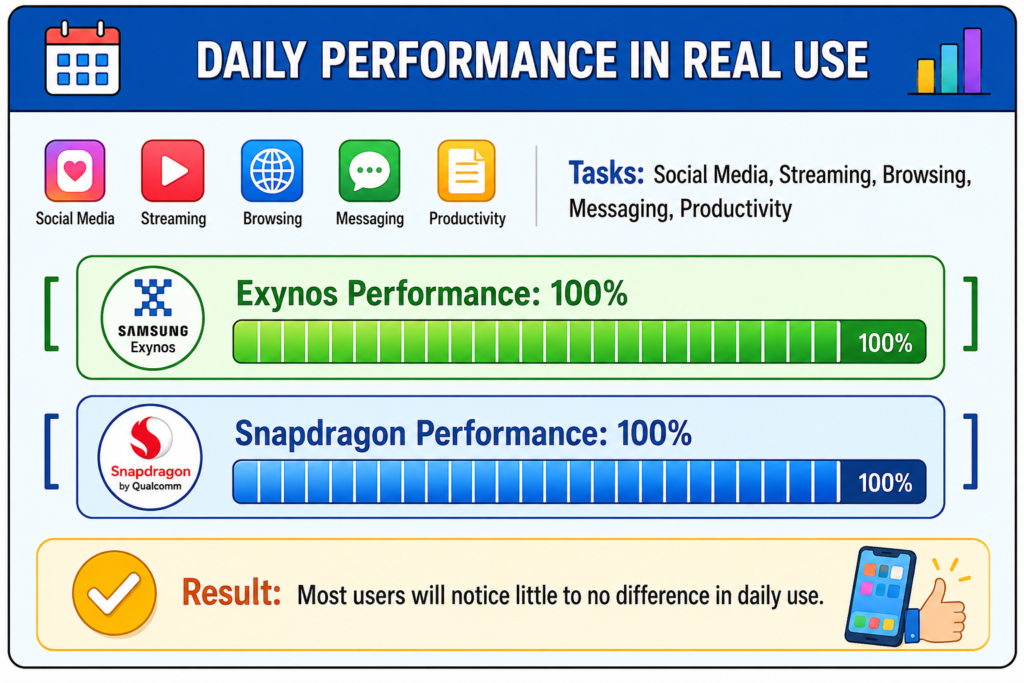
The differences appear when running intensive applications. The Snapdragon platform has a slight edge when doing things like rendering a 4K video project, exporting compressed audio files and other heavier creative tasks. Qualcomm’s custom CPU design has historically been better at handling extended heavy usage, so the phone can finish demanding processing work slightly faster than its Exynos counterpart.
In my experience, most users would struggle to tell the difference between Exynos and Snapdragon during casual use in 2026. Modern flagship phones are simply so fast now that everyday tasks rarely stress the hardware. The gap usually becomes visible during:
- Gaming for long periods
- Extended camera usage
- AI-heavy processing
- Demanding multitasking
That is where heat management and sustained performance matter far more than short benchmarks.
Snapdragon vs Exynos Gaming Performance
The difference between Exynos vs Snapdragon Samsung phones is most noticeable when it comes to mobile gaming. This is the area where Snapdragon has traditionally performed better and it is a key reason many gamers preferred Snapdragon models.
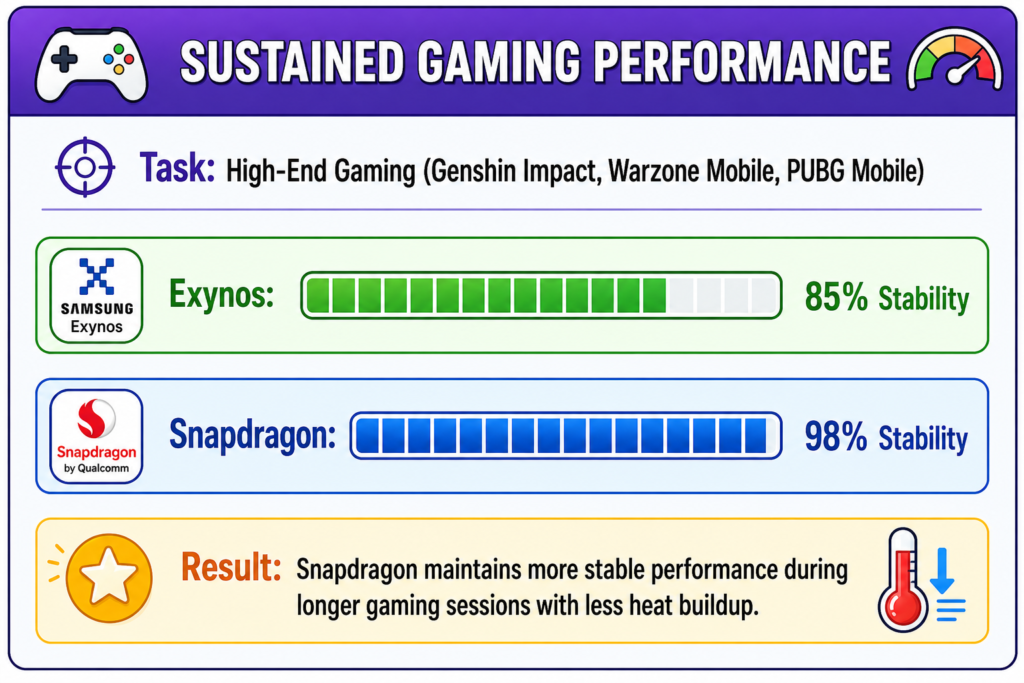
A major advantage for Snapdragon is its custom Adreno graphics processor (GPU). Adreno architecture is considered by many as the highly efficient mobile GPU in the Android ecosystem. It has the advantage of decades of optimisation, and mobile game developers often optimize games for Snapdragon chips. The biggest difference in Snapdragon vs Exynos gaming performance appears during long gaming sessions with maximum graphics settings. If you are playing high-end mobile games like Genshin Impact, Call of Duty: Warzone Mobile or PUBG Mobile at max graphic settings, the Snapdragon variant offers stable frame rates and sustained high performance for hours on end.
Samsung recognized its graphics limitations and made a significant shift by partnering with AMD to bring AMD’s RDNA graphics architecture to Exynos GPUs. By 2026 this collaboration has significantly improved Exynos’ graphics performance. Modern Exynos chips are very good at handling advanced visual effects.
Exynos GPU hardware has improved significantly but real-world performance can still vary optimization remains inconsistent in some games. There are far fewer Exynos flagship devices in the world than in the much larger Snapdragon ecosystem, and game developers usually optimize more heavily for Snapdragon hardware. This leads to an Exynos user experiencing occasional frame drops or high power consumption, while the Snapdragon variant runs smooth.
Exynos vs Snapdragon Battery Life and Heat Management
The difference in heat management has narrowed significantly in 2026, but it is still there. Battery efficiency is still an important factor when comparing Exynos vs Snapdragon Samsung phones. Excessive heat during gaming and AI processing can also accelerate long-term battery degradation. We explained this in detail in our complete phone battery health guide. When comparing Exynos vs Snapdragon battery life, Snapdragon variants still maintain a slight efficiency advantage. The better power efficiency that Qualcomm’s Snapdragon chips still tend to deliver is simply better. In real-world battery tests, a Snapdragon-powered Galaxy phone typically offers slightly more screen-on time than its Exynos sibling. That advantage is most obvious on cellular data (rather than Wi-Fi). According to Qualcomm modem documentation, Qualcomm’s 5G modem systems are incredibly efficient at maintaining weak cellular signals without generating excessive heat.
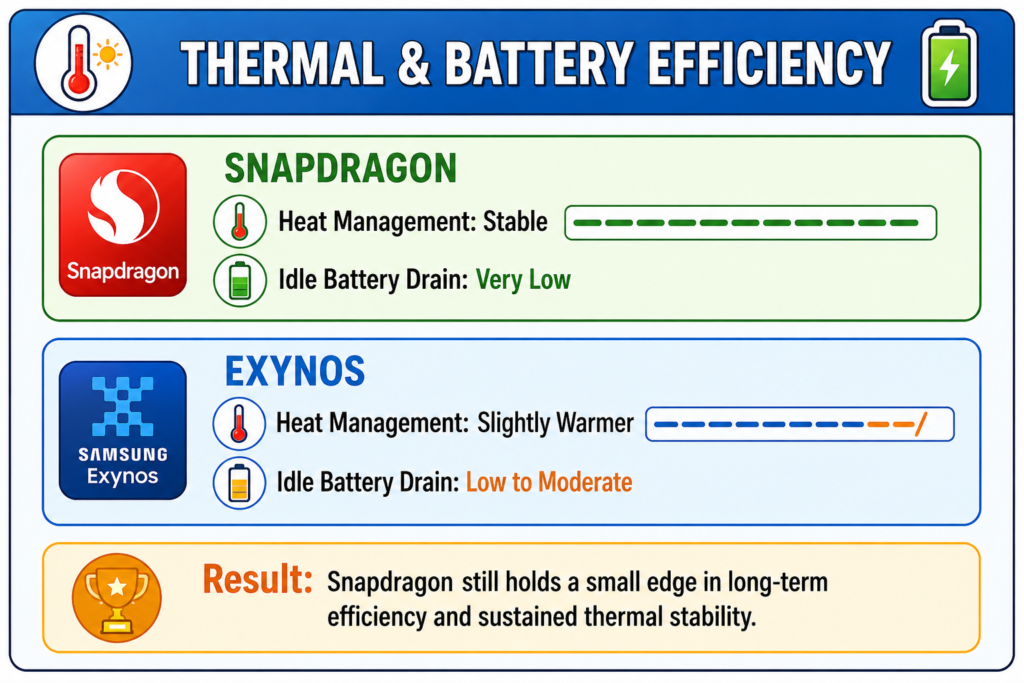
In the past, Samsung has solved thermal issues by significantly improving the cooling system inside its phones. According to the gsmarena teardown, modern Exynos flagships have large vapour chambers that manage processor heat much better than previous models. Sure, an Exynos variant may still run a little hotter than a Snapdragon phone during a heavy gaming session or when recording outdoor 4K video, but it no longer overheats or shows the severe throttling in previous Exynos models.
How the Chip Affects Camera Quality
It’s a common misconception that the quality of a smartphone camera depends only on its lenses and sensors. Modern smartphone photography relies heavily on computational processing, where the chipset plays almost as important a role as the camera hardware itself. The camera sensor mainly captures raw image information. The Image Signal Processor (ISP) which is built right into the main chipset is responsible for the final look of your photo, including the colours, dynamic range, sharpness and the clarity in low light.
Exynos and Snapdragon have different ISPs, so a photo or video shot on the same model of phone can look a little different depending on which regional chip is inside.
- The Snapdragon Photographic Style: Snapdragon’s ISP is tuned for more vibrant images. It does advanced HDR processing very well. It makes sure that skies aren’t blown out and better shadow detail. And Qualcomm’s video processing means slightly sharper video stabilisation and reduced image noise when recording video in low-light conditions.
- The Exynos Photographic Style: The Exynos ISP is more natural-looking in appearance. It prefers realistic colour representation over overly saturated colors, which usually results in better skin tones and softer, more lifelike landscapes.
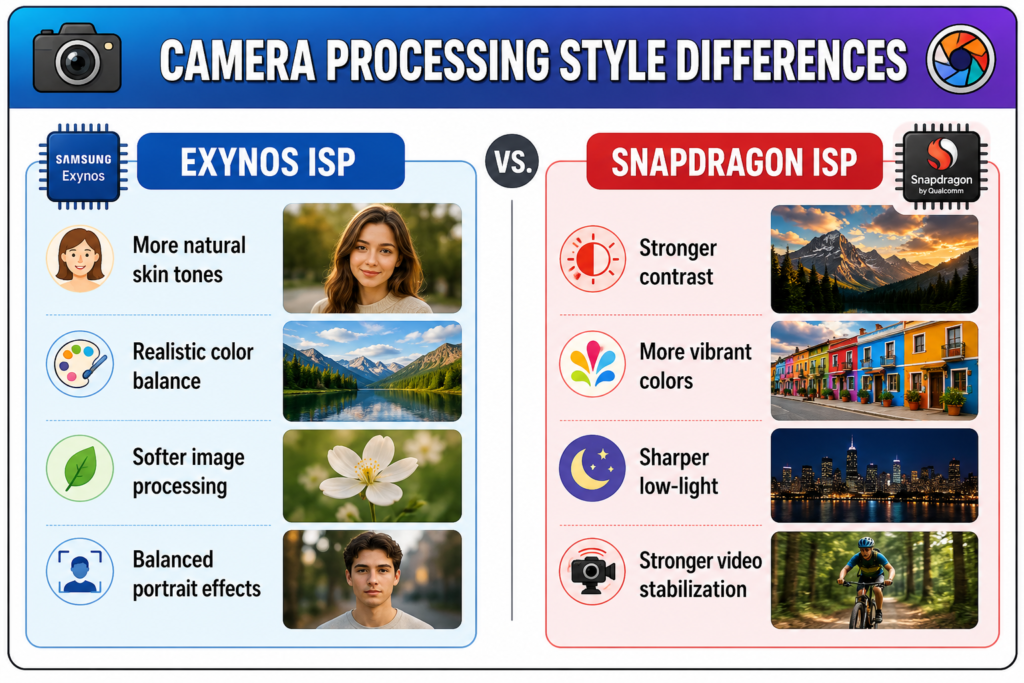
Some of these style differences may be noticed by professional photographers when comparing uncompressed images side by side on a colour calibrated monitor, but the difference is not significant for casual shooting. Both chipsets use Samsung’s unified computational photography software, so whether your phone uses Exynos or Snapdragon, your social media posts, family portraits and casual videos will still look excellent.
Galaxy AI Performance Snapdragon vs Exynos
AI processing is now a major part of the Exynos vs Snapdragon Samsung phones comparison. Artificial intelligence has evolved from an industry trend to the major focus of modern smartphones. As AI workloads become heavier, many users are also starting to wonder whether modern AI features are slowing down Android phones during extended workloads and gaming sessions. Samsung now heavily focuses on its Galaxy AI suite, which includes real-time voice translation during phone conversations, generative image editing, automated audio transcription and context-aware writing assistants.
Chipmakers put a dedicated processor inside the device, a Neural Processing Unit (NPU), so Samsung now heavily focuses on the device instead of slow cloud processing systems.
Modern Galaxy AI features also consume more RAM over time, especially when a bunch of AI services are working continuously in the background. If you want to see how this plays out in today’s phones, read our full guide on how much RAM smartphones actually need in 2026.
The discussion around Galaxy AI performance, Snapdragon vs Exynos has become much more important in 2026 smartphones. Qualcomm’s Hexagon NPU is one of the strongest AI engines in smartphones. It has very strong AI processing power, making it possible to run multiple AI tasks efficiently. On a Snapdragon Galaxy device, deleting unwanted objects from a picture or creating a summarised transcript of a long voice recording is extremely fast. Third-party app developers also do strong optimization, which is part of the Snapdragon NPU experience, so independent AI apps and filters often run faster on Qualcomm hardware.
But Samsung has built in the Exynos architecture with an eye on AI processing. Samsung designs both the Galaxy AI features and the Exynos NPU, enabling tight system integration. The Exynos chip handles One UI’s internal machine learning routines beautifully, running features such as predictive battery management and background system optimisation smoothly.
In practice, Snapdragon still tends to hold a small advantage in heavier third-party AI workloads, but modern Exynos chips are now far more competitive than earlier generations when handling Samsung’s native Galaxy AI features
Long-Term Performance and Software Support
Historically, picking a Snapdragon variant was a more reliable long-term choice for a four or five year old smartphone. Older Exynos chips didn’t age well, as the Android operating system grew heavier and app developers updated their apps to target newer hardware, Exynos phones would often experience performance degradation and sluggishness later in their lifecycle.
Samsung has improved this considerably, largely thanks to Samsung’s new software policy. According to the Samsung Security Policy Page, Samsung now offers some of the longest Android support for major Android OS updates and security patches it delivers to its flagship devices, at seven years. To support this, Samsung engineers now build Exynos processors with a more long-term performance capacity to make sure they’ll be able to handle the more demanding future apps and AI features.
By 2026, Samsung seems much more focused on long-term consistency and AI efficiency rather than simply chasing short benchmark wins. For most people keeping a phone four or five years, that matters far more than tiny launch-day performance differences.
Direct Comparison Breakdown
To help visualize how these two processor variants stack up against each other across key performance vectors, review this breakdown of their architectural strengths:
| Feature/Category | Snapdragon Variant | Exynos Variant |
|---|---|---|
| Chip Developer | Qualcomm (USA) | Samsung Electronics (South Korea) |
| Everyday UI Performance | Smooth and Responsive | Flawless, highly responsive |
| Long Gaming Sessions | More sable sustained performance | Good overall performance but slight frame drops in some heavy games |
| Graphics Processing | Adreno GPU with strong game optimization | Xclipse GPU based on AMD RDNA graphics technology |
| Heat Management | Runs cooler under load | Slightly warmer during heavy workloads |
| Battery Life | Slightly better efficiency | Very good daily endurance |
| Cellular Connectivity | Excellent modem efficiency | Realistic connectivity |
| Camera Processing Style | More vibrant and high-contrast images | More natural color tones and softer processing |
| Galaxy AI Performance | Faster third-party AI tasks | Deeply integrated execution via native NPU |
| Software Support | 7 years of One UI updates | 7 years of One UI updates |
The Decision: Which One Should You Choose?
Even though the gap between Exynos and Snapdragon has narrowed significantly, there are still some users who may benefit more from choosing a Snapdragon-powered Galaxy phone. Choosing between Exynos vs Snapdragon Samsung phones now depends more on your usage style than massive performance differences.
Choose Snapdragon Model
- If you are a hardcore gamer who plays competitive mobile games for long stretches and you need stable frame rates, Snapdragon is the way to go.
- If your lifestyle means you’re away from a charger for long periods of time and you rely on mobile data a lot, the Snapdragon’s more efficient modem will get you more reliable battery endurance.
- If you’re a heavy content creator, frequently edit videos, shoot 4K/8K video, and need to export files quickly, Qualcomm’s chip will save you time.
Choose Exynos Model
If you live in a region where Samsung distributes the Exynos variant, you can buy the phone with confidence if you fall into any of these categories.
- If you are a typical smartphone user and use your smartphone for web browsing, communication, productivity and watching Netflix, YouTube and social media, the Exynos variant offers a flagship experience.
- If you like natural photos and prefer more natural colors and skin tones over more saturated and processed images, the Exynos ISP produces very natural-looking photos.
- If you want a device with Samsung ecosystem features, including integrated productivity tools and Galaxy AI features, the well optimized Exynos chip runs these smoothly.
Final Verdict
A few years ago, the differences could genuinely affect battery life, heat, and gaming stability. In 2026, the gap between Exynos vs Snapdragon Samsung phones is smaller than ever. The major differences in performance and battery life have reduced to the point where most people will rarely notice in daily use.
Qualcomm Snapdragon chips are still the preferred option for power users, users who care about peak performance, and hardcore gamers thanks to their great GPU design and heat management. But, in the meantime, Samsung’s Exynos chips have improved significantly and offer a very capable alternative that easily delivers a premium experience.
Buying a Samsung flagship today doesn’t put you in a processor lottery where one outcome is a loss. Both versions are high-end flagship hardware, so you can worry less about processor specifications and more about enjoying your device.
Is Snapdragon better than Exynos in 2026?
Snapdragon chipsets still perform slightly better in gaming, heat management and sustained performance. Modern Exynos chips, however, have come a long way, and most users will rarely notice a difference in day to day usage.
Exynos or Snapdragon: which Samsung phone should you buy?
The Snapdragon version is usually the stronger choice if you’re a gamer, heavy multitasker, or content creator. Now, everyday users interested in social media, streaming, photography and productivity can enjoy the smooth flagship experience from Samsung phones powered by Exynos.
Which is better for gaming: Exynos or Snapdragon?
Because of its better heat management and the more efficient Adreno GPU, Snapdragon still holds an advantage for gaming, especially during longer gaming sessions. In high-end mobile games like PUBG Mobile and Genshin Impact, it generally holds more stable frame rates.
Does Exynos still overheat in Samsung phones?
Older Exynos chips had heating issues, but Samsung has improved cooling systems and vapor chamber technology significantly in recent Galaxy phones. Modern Exynos devices run much cooler than previous models.
Which processor is better for Galaxy AI features?
Both processors handle Samsung Galaxy AI features smoothly. However, Snapdragon chips usually perform slightly better in more demanding AI workloads like image generation, live transcription, and complex AI photo effects.